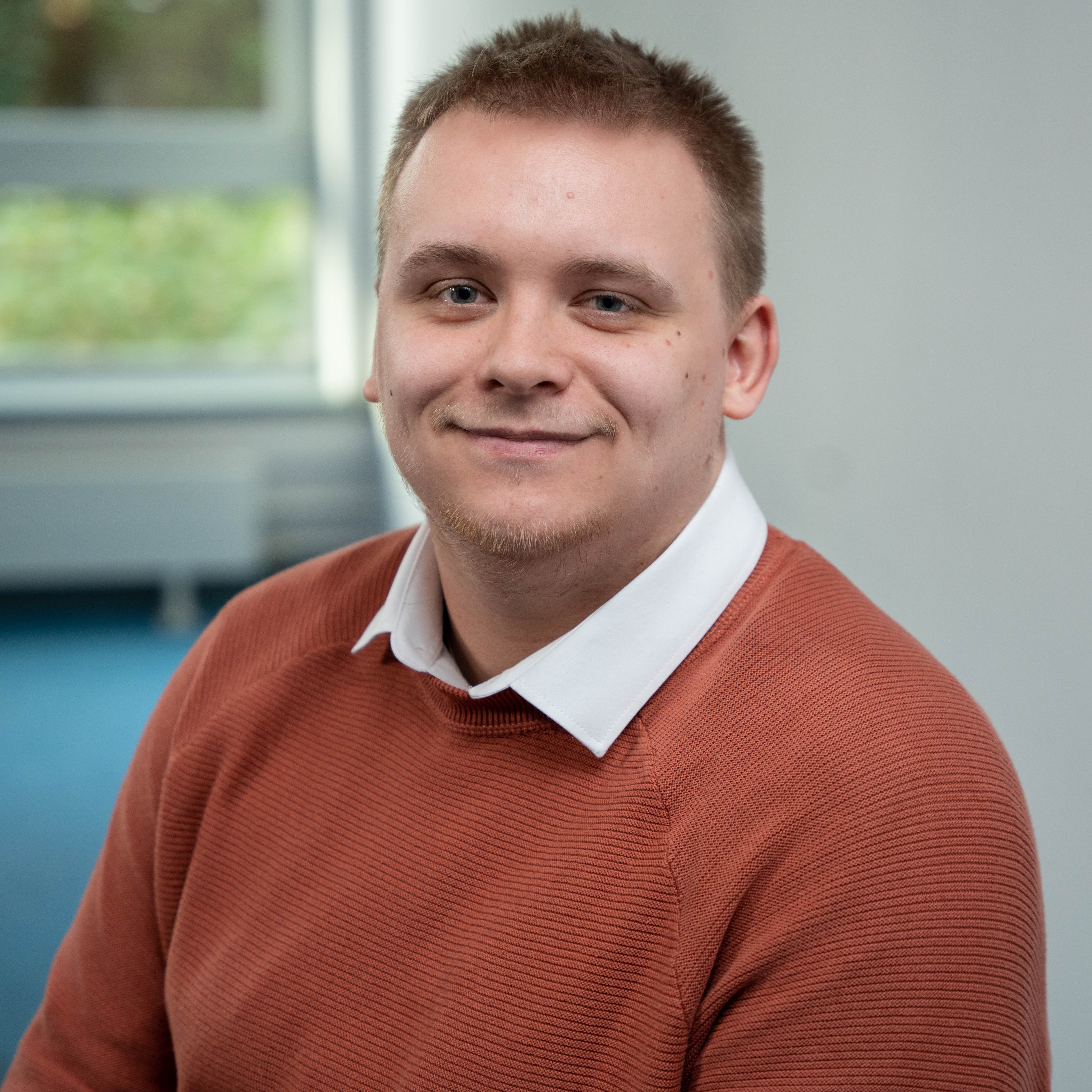
Hi, I’m Callum, a Graduate Teaching Assistant and PhD Student at Edge Hill University in the United Kingdom working within the Computer Science Department, specialising in artificial intelligence, medical informatics, and cyber security. With a passion for both academia and industry, I combine teaching undergraduate and postgraduate computer science and cyber security courses with research in the field of AI and medical informatics.
Having earned a Bachelor of Science degree in Computer Science, this educational background laid the groundwork for subsequent pursuits of a Master of Science degree in Cyber Security. Currently pursuing a Doctoral degree, I focus my research on the intersection of artificial intelligence and medical informatics. My doctoral thesis, titled “Early Detection and Diagnosis of Parkinson’s Disease Dementia Using Deep Learning” aims to develop innovative approaches to identify and diagnose Parkinson’s Disease Dementia at an early stage, enabling timely intervention and improved patient care.
In addition to my research pursuits, I also serve as a Graduate Teaching Assistant, sharing my expertise with undergraduate and postgraduate students in the fields of computer science and cyber security. This experience as a teaching assistant allows me to effectively communicate complex concepts, mentor aspiring students, and create an engaging learning environment.
My Background
I have a strong academic foundation in technology and research, holding an MSc in Cyber Security from Edge Hill University, completed in 2022. My master’s dissertation focused on advancing the field of adversarial attacks, specifically improving their effectiveness on deep learning-based medical systems through the use of reinforcement learning. This work highlights my interest in both cutting-edge AI applications and the security challenges associated with them.
Prior to this, I completed a BSc in Computer Science at Edge Hill University in 2021. My undergraduate dissertation centred on developing effective human facial emotion recognition systems using deep learning techniques. This project reflects my passion for artificial intelligence and its ability to address complex problems in human-computer interaction. Together, these experiences have equipped me with a robust skill set in machine learning, cybersecurity, and applied research.
My Research
My research journey has spanned diverse applications of artificial intelligence and deep learning, particularly in healthcare and geospatial data. Currently, I am a Graduate Teaching Assistant at Edge Hill University, where I balance teaching responsibilities with ongoing research in AI and medical informatics.
During my time as a Research Assistant from March to August 2021, I co-authored the paper titled “Adaptive Multiscale Superpixel Embedding Convolutional Neural Network for Land Use Classification” (AMUSE-CNN). This research addressed the challenges of land use classification using high-resolution remote sensing imagery. The AMUSE-CNN model introduced an innovative architecture that integrates superpixel embedding and multiscale convolutional neural networks to enhance classification accuracy. It leverages adaptive strategies to optimise scale selection for diverse land use classes, enabling precise identification of complex geographical features. This work was validated on datasets from Lagos and Kano, Nigeria, demonstrating superior performance compared to existing state-of-the-art methods
In my role as Research Projects Coordinator from April to September 2022, I was involved in pioneering research that led to the publication of Early Detection of Parkinson’s Disease Dementia Using Dual-Sided Multi-Scale Convolutional Neural Networks (DSMS-CNN). This study addressed a critical need in medical diagnostics by proposing a novel dual-sided multi-scale deep learning approach to analyse the cholinergic basal forebrain in MRI data, enabling early prediction of Parkinson’s Disease Dementia. This research combined super-resolution imaging with advanced convolutional architectures to achieve state-of-the-art performance, significantly improving upon existing methods.
These projects not only highlight my technical expertise but also my ability to lead interdisciplinary research efforts. My work as Research Projects Coordinator further laid the groundwork for my PhD, which focuses on advancing AI applications in healthcare diagnostics. This progression demonstrates my dedication to leveraging AI to solve complex, real-world problems.